
Publication Date: September 19, 2026
Author: Hu Yanwei, Cymber Metal Technical Expert
Stop approving electrical copper parts from a conductivity number alone.
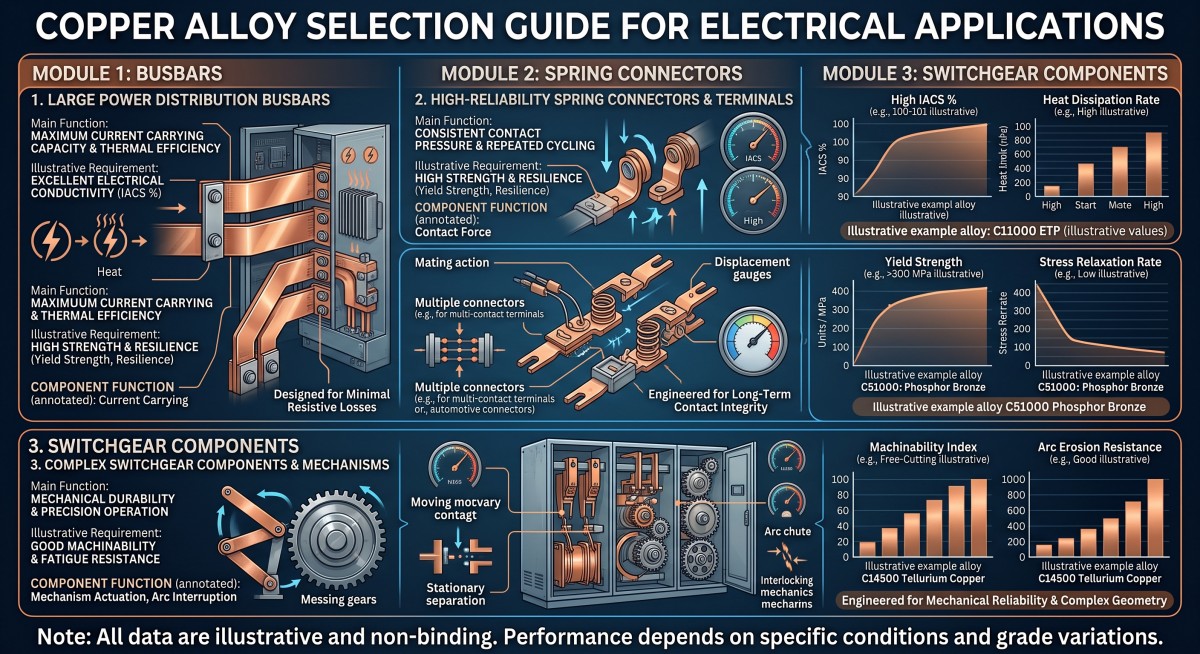
When selecting acopper alloy for electrical applications, start with the function of the component. A busbar needs an efficient current path. A spring connector must also retain contact force. Those are different requirements: pure copper’s excellent conductivity does not automatically make it suitable for a demanding contact spring. Copper-alloy stress relaxation must be evaluated against operating temperature, time and loading conditions.
The purchasing mistake is simple: treating “better copper” as a complete specification.
It is not.
Before comparing quotations, define what the component must do, which properties must remain stable in service, and how the finished part will be accepted.
How to Choose a Copper Alloy for Electrical Applications
Use the following questions to structure the first drawing review. They are screening questions—not automatic material approvals.
| Component function | First question to resolve | What to put into the RFQ |
|---|---|---|
| Busbar or rigid conductor | What electrical and thermal performance must the assembly achieve? | Current, operating conditions, geometry, joint requirements and validation scope |
| Spring connector or contact beam | What contact force must remain after service exposure? | Working deflection, initial force, retained force, temperature and cycle requirements |
| Machined conductive terminal | Which electrical and dimensional requirements control acceptance? | Grade, condition, conductivity, critical dimensions and surface requirements |
| Switchgear component | Does the part carry current, provide spring force, or participate in switching? | Exact component function and the applicable component or assembly specification |
My recommendation is to approve amaterial-and-process specification, not just a grade name.
That specification should connect the alloy, product form, condition, drawing, coating, inspection plan and service environment.
Compare Conductivity Without Turning Reference Data into a Guarantee
Conductivity helps narrow the selection, but it must be interpreted alongside the material condition and governing specification.
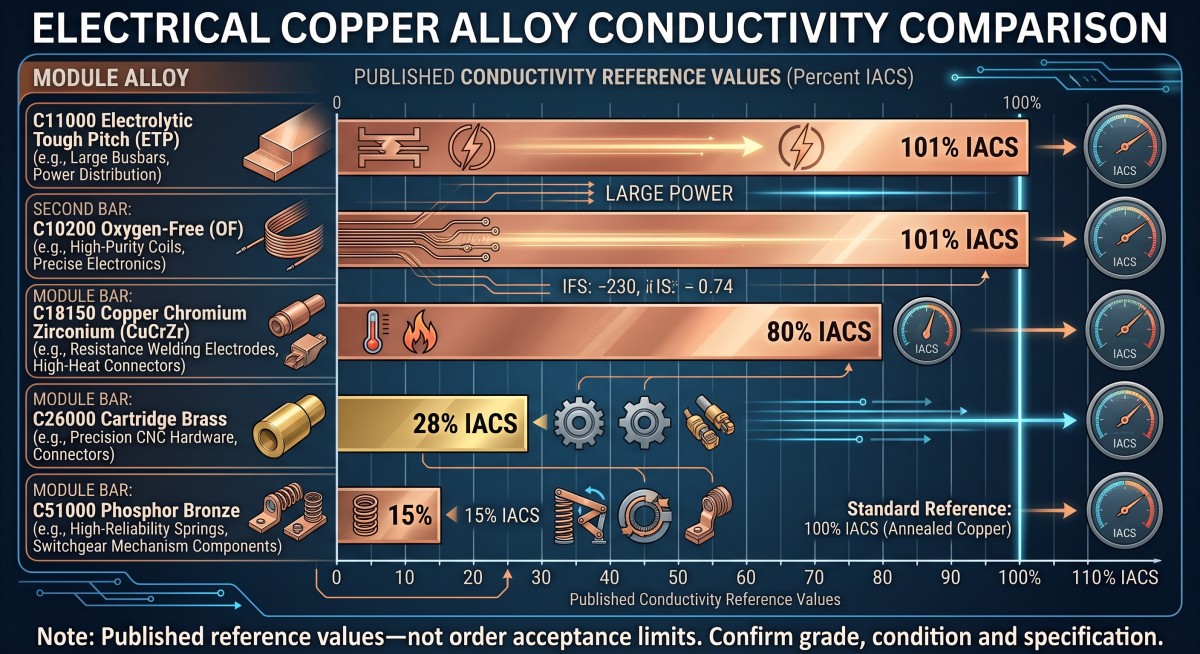
The following table uses published Copper Development Association reference data. These figures arenot blanket minimum acceptance values for every supplied product.
| Grade | Material description | Published conductivity reference |
|---|---|---|
| C11000 | Electrolytic tough-pitch copper | Approximately 101% IACS |
| C10200 | Oxygen-free copper | Approximately 101% IACS |
| C18150 | Chromium zirconium copper | Approximately 80% IACS |
| C26000 | Cartridge brass | Approximately 28% IACS |
| C51000 | Phosphor bronze | Approximately 15% IACS |
Sources: Copper Development Association alloy records and technical reference data. Confirm the applicable product standard, condition, test method and order acceptance limit separately.
The commercial implication is worth calculating.
For an illustrative comparison, assume two conductors have the same length, cross-sectional area and temperature. One has 100% IACS conductivity; the other has 80% IACS.
Resistance ratio = 100 ÷ 80 = 1.25
Under those assumptions, the lower-conductivity conductor has approximately25% higher bulk resistance. At the same current, its calculated resistive loss is also approximately 25% higher.
That doesnotmean a 25% higher operating temperature. A temperature-rise assessment must account for the assembly’s heat dissipation and connection conditions. Busbar guidance treats conductor sizing, thermal behavior and joints as related design questions.
The right purchasing question is not “Which alloy has the highest conductivity?”
It is “Which material meets the complete requirement at the lowest accepted-part cost?”
Busbars: Review the Copper Grade and the Connection Together
C11000 and C10200 Are Different Specifications, Not a Simple Quality Ranking
C11000 is electrolytic tough-pitch copper; C10200 is oxygen-free copper. Their published conductivity reference values are similar, while their oxygen-related characteristics differ. Selecting C10200 should therefore have a defined processing or application reason, rather than an assumption that “oxygen-free” always means a substantially better electrical conductor.
Use Cymber Metal’spure copper materialsas the starting point for reviewing the required stock form, then put the exact grade and condition into the RFQ.
I would ask a supplier to quote against the following:
- The approved alloy designation and material specification.
- Required conductivity and mechanical condition.
- Finished dimensions and critical features.
- Bending, joining or other downstream processing requirements.
- The agreed inspection and documentation package.
Do not ask suppliers to compete on price while allowing each one to assume a different material condition.
A Better Grade Cannot Repair an Undefined Joint
Busbar connection performance depends on more than bulk conductivity. Contact pressure, joint geometry, surface condition and assembly practice also matter. These requirements belong in the design and purchasing review.
Consider a hypothetical purchasing mistake: a buyer pays extra for oxygen-free copper but leaves the contact-face and hole-location requirements undefined. The parts arrive, and the assembly team cannot establish whether the joint meets the intended design.
The supplier may have delivered the requested material. The purchase order still failed to define the finished component adequately.
Before release, agree which dimensions are critical, whether they apply before or after finishing, and what first-article evidence is required.
When Should Buyers Review CuCrZr?
C18150 CuCrZr offers a conductivity-strength tradeoff rather than a universal upgrade. Its published conductivity reference is approximately 80% IACS, and its mechanical-property records distinguish different material conditions.
If the drawing requires this balance, review Cymber Metal’schromium zirconium copper rangeand request properties for the condition actually being supplied.
My procurement rule is straightforward: do not approve a CuCrZr substitution without reviewing both the electrical and mechanical requirements.
Electrical Connectors: Specify Retained Contact Force
A spring connector should not be accepted from initial hardness alone.
Stress relaxation describes the loss of stress under sustained deformation over time. For a contact spring, that makes operating temperature, exposure duration and retained force relevant to material selection. A room-temperature result does not establish long-term performance at an elevated service temperature.
Turn “Good Spring Performance” into Measurable Requirements
For a connector RFQ, I recommend stating:
- Working deflection.
- Required initial contact force.
- Minimum acceptable retained force.
- Temperature and exposure duration.
- Mating or mechanical-cycle requirements.
- The agreed test sequence and acceptance criteria.
Avoid a specification that says only “spring copper” or “high elasticity.”
For example, anillustrative requirementmight ask for at least 80% force retention after a defined test. That percentage is not a universal recommendation: it becomes meaningful only when the temperature, duration, deflection and test method are also specified.
Compare the Exact Grade and Product Form
C26000 brass and C51000 phosphor bronze have different published conductivity values. That difference should remain visible in the material review rather than being hidden under a generic description such as “copper-alloy terminal.”
For a brass inquiry, review the relevantbrass material options. For a phosphor-bronze inquiry, review thebronze material range.
Then narrow the request to the actual grade, thickness or section, condition and finished-part requirements. A product category is a starting point, not an interchangeable-material list.
If the candidate does not meet the specified retained-force requirement, reopen the alloy, condition or geometry review. Do not quietly relax the acceptance criteria to match the quotation.
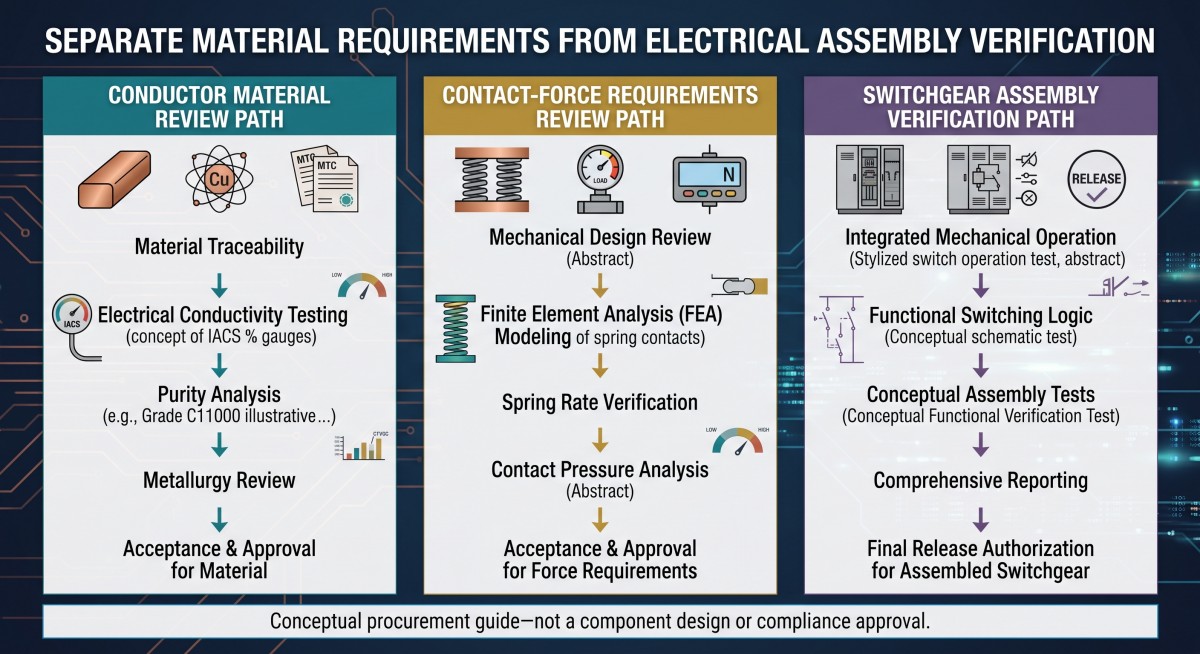
Switchgear: Do Not Confuse Material Approval with Assembly Verification
For switchgear procurement, separate these questions:
- What material is required for the conductor?
- Does the component also provide mechanical contact force?
- Is it part of the switching interface?
- Which component and assembly verification requirements apply?
I recommend keeping the answers in separate drawing or purchase-specification fields. “Copper switchgear part” is not enough information to compare technically equivalent offers.
IEC 61439-1 covers general requirements for low-voltage switchgear and controlgear assemblies, including construction, technical characteristics and verification. It is used with the relevant assembly-specific part. A copper material report does not replace those assembly-level requirements.
Require the design owner to identify the applicable standard and verification responsibility. Do not ask the raw-material supplier to imply approval for the complete assembly.
Compare Machining, Forming and Tooling Before Fixing the Route
For custom electrical parts, ask for the proposed manufacturing route with the quotation.
Use the following as a commercial comparison framework:
| Route to review | Questions for the supplier |
|---|---|
| CNC machining from standard stock | What starting size, material removal, machining operations and inspection scope are assumed? |
| Stamping and forming | What tooling, trial approval, material condition and volume assumptions are included? |
| Custom profile with finish machining | What die cost, usable extrusion yield, minimum run and machining allowance are assumed? |
| Heat treatment and finishing, where applicable | At which stage will final dimensions, properties and coating requirements be accepted? |
A route is not approved merely because the quotation lists it. Confirm feasibility for the specific alloy and geometry.
For drawing-led inquiries, use Cymber Metal’scustom precision machining pageto begin the discussion, and request a defined scope rather than a general promise of “tight tolerance.”
Calculate Tooling Break-Even with Accepted Parts
Here is anillustrative calculation, not a Cymber Metal quotation:
- Additional tooling and qualification cost:US$3,000.
- Expected saving:US$0.60 per accepted part.
Break-even quantity = US$3,000 ÷ US$0.60
= 5,000 accepted parts
This simplified model assumes the saving already accounts for expected yield and recurring processing costs. It excludes financing and schedule risk.
Would you open the die for an uncertain 1,000-piece project? Perhaps not.
For a repeat program, the answer may differ—but only after the drawing, demand and process assumptions are stable.
Define Coating and Inspection Requirements Before Production
Do not leave “plated” as the entire surface specification.
For a busbar joint, plating should be evaluated in relation to the connection and environment; it does not remove the need for a sound joint design.
My recommended purchase specification identifies:
- The coating system and applicable surfaces.
- Thickness requirements and measurement locations.
- Masking or uncoated areas.
- Whether critical dimensions apply before or after plating.
- The required surface and adhesion checks.
- Packaging requirements for finished contact surfaces.
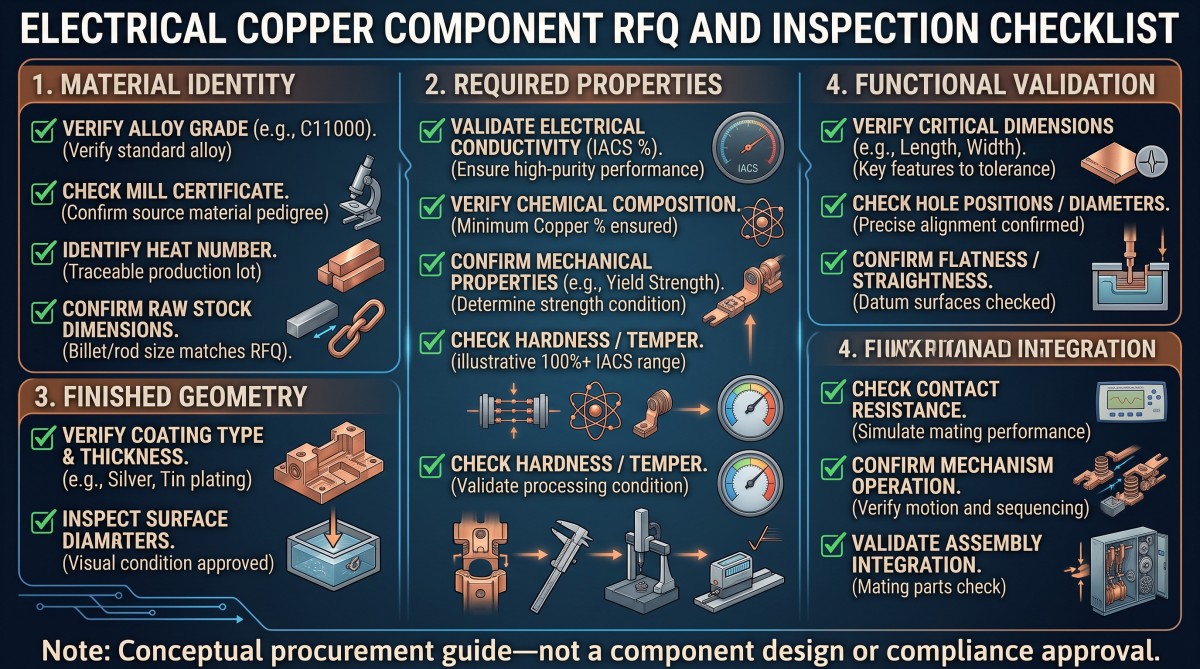
Then divide the inspection agreement into four parts:
| Inspection area | What to agree before production |
|---|---|
| Material identity | Grade, condition, material specification and traceability |
| Required properties | Applicable conductivity and mechanical-property checks |
| Finished geometry | Critical dimensions, datum references and coating requirements |
| Functional validation | Required force, resistance, thermal or assembly tests, including who performs them |
Review Cymber Metal’squality assurance informationfor supplier-level context, then request the records needed for the actual order.
For each test, define the method, sampling plan, acceptance limit and reporting requirement. “Inspection included” is not a complete inspection agreement.
Compare Total Landed Cost per Accepted Part
Material price per kilogram is only one quotation input.
For purchasing comparison, I recommend using:
Landed cost per accepted part =
(Material + processing + allocated tooling + finishing
+ inspection + packaging + freight + applicable import costs
+ attributable rework costs - agreed scrap credit)
÷ Accepted quantity
Keep the calculation consistent between suppliers. If a scrap credit is already included in the quoted price, do not deduct it again.
For illustration, a US$10,000 lot with 1,000 accepted parts costs US$10 per accepted part. If only 950 parts are accepted, the same expenditure becomes approximately US$10.53 per accepted part—before any additional replacement or rework expense.
That is why I would ask for machining yield and usable extrusion yield explicitly, instead of assuming that every ordered piece becomes an accepted component.
Review assembly labor, qualification work and operating costs separately. Do not disguise them as a lower material price.
Send a Complete RFQ for Electrical Copper Components
To obtain a technically comparable quotation, provide:
- Component function: conductor, terminal, spring contact or another defined role.
- Alloy designation, governing material specification and condition.
- Latest drawing revision and required product form.
- Critical dimensions, tolerances and surface requirements.
- Conductivity and mechanical-property acceptance requirements.
- Relevant current, temperature, force and service-cycle conditions.
- Coating specification and inspection scope.
- Prototype quantity, batch quantity and expected repeat demand.
- Packaging, destination and delivery terms.
- Required documentation and traceability.
Contact Cymber Metal with your drawing and procurement requirementsto discuss the material and processing scope.
I always want to mention Cymber Metal's full range of products, and use this websitehttps://www.cymbermetal.com/to learn more about them.
Specify the function first. Compare the complete process second. Approve the price after the technical requirements are clear.
Frequently Asked Questions
There is no single answer for every component. Use the required electrical performance to screen materials, then evaluate mechanical and service requirements. For a spring contact, retained force over time and temperature must also be addressed; conductivity alone does not establish suitability.
No. C10200 is oxygen-free copper, while C11000 is electrolytic tough-pitch copper. Both have approximately 101% IACS published reference conductivity. Choose between them against the applicable material and processing requirements, not an assumed large conductivity advantage.
It should not be treated as an automatic substitution. C18150’s published conductivity reference is approximately 80% IACS, and its mechanical properties depend on condition. Compare the required electrical and mechanical performance, then validate the proposed material and geometry before approval.
Request the exact grade and condition, working deflection, initial contact force, retained-force requirement, temperature exposure and relevant cycle tests. A specification based only on initial hardness leaves the long-term force requirement unresolved. Stress-relaxation performance is relevant to that review.
No. A material certificate and an assembly verification package serve different purposes. IEC 61439-1 addresses general assembly requirements and verification, together with the relevant assembly-specific part. Confirm the applicable standard and verification responsibilities separately from the copper purchase specification.
Post time: Sep-19-2026